What licence do I need to sell products online in Dubai? It's the first question every online seller should answer before taking a single payment. Selling products online in Dubai without the correct licence is illegal, and that applies whether you're running a full Shopify storefront, selling handmade goods on Instagram, or listing products on Noon. The UAE takes this seriously. Penalties for unlicensed trading range from fines to account suspensions to full business closure.
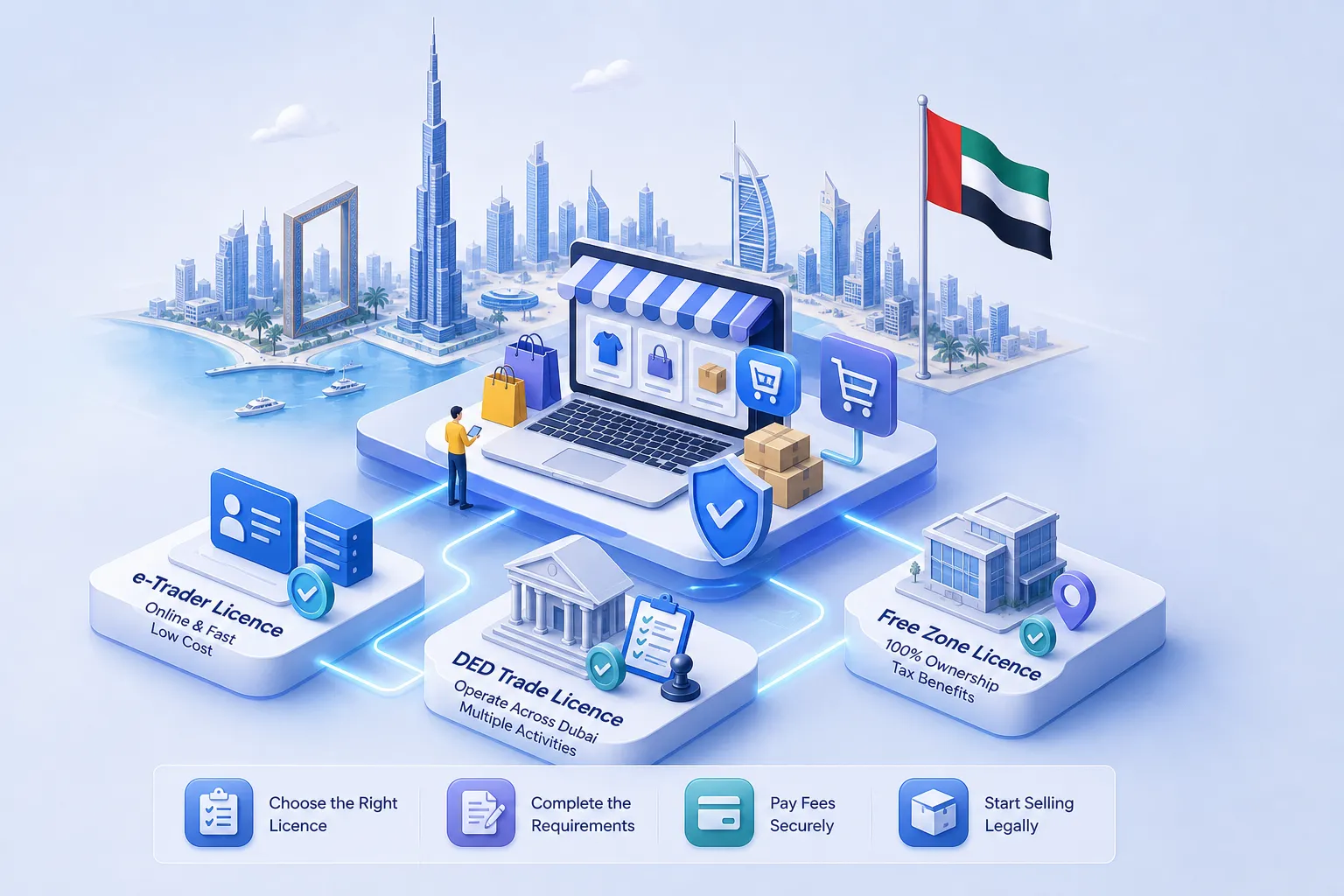
The framework, fortunately, is not complicated. There are three legitimate paths to get properly licensed for online selling in Dubai: the e-Trader licence, the DED mainland commercial trade licence, and the free zone e-commerce licence. The right one depends on your residency status, your business structure, and where your customers are. Entrepreneurs who work with an experienced consultancy like Titan Partners International typically get the right licence identified and issued within a few business days, without the back-and-forth of figuring it out alone.
By the end of this article, you'll know exactly which licence fits your situation, what it costs, what documents you need, and what TDRA e-commerce approval actually means for your online business.
What licence do I need to sell products online in Dubai? The three options explained
The e-Trader licence: for individuals and home-based sellers
The e-Trader licence is the most accessible entry point for solo operators. Issued by Dubai's Department of Economy and Tourism, it's designed specifically for individuals selling products or services online within the UAE. This is a personal trading licence issued under your own name, not a company structure. It covers social media sellers, home-based businesses, and individual online traders who don't need a formal company entity.
The DED mainland trade licence: for businesses selling locally
Any business entity that wants to sell products to UAE mainland consumers through a website, app, or marketplace needs a commercial trade licence with an e-commerce activity registered under it. This is the route for entrepreneurs who want a formal company structure, the ability to hire staff, and direct access to the full mainland market. It carries more setup requirements and higher costs, but it gives you the most comprehensive trading rights inside the UAE.
The free zone e-commerce licence: for digital-first and international sellers
Free zones like SHAMS in Sharjah, RAKEZ in Ras Al Khaimah, IFZA, and Meydan offer dedicated e-commerce or trading licences for businesses that primarily operate online or sell internationally. These are popular with startups and digital entrepreneurs because of lower setup costs and 100% foreign ownership. One important caveat: selling directly to UAE mainland consumers through your own storefront may require additional arrangements. A free zone e-commerce licence suits many online sellers, but confirm this fits your model before committing.
Who qualifies and what the residency rules actually mean
Why Dubai residency is required for the e-Trader route
The Dubai e-Trader licence requires a valid UAE residence visa and Emirates ID. If you're not a Dubai resident, you're not eligible for this particular licence. Full stop. Expats living in Dubai on an employment visa may also need a No Objection Certificate from their employer before applying, since the licence is tied to the sponsoring company's awareness and approval.
How expats and non-residents can still get an online seller licence in Dubai
The free zone route is open to non-residents and first-time UAE investors, making it the practical entry point for international entrepreneurs who want to start an online business without relocating first. A free zone company can be set up remotely and gives you a legitimate legal framework for online trading in the UAE. You don't need a UAE residence visa to incorporate, though you'll need one eventually if you plan to relocate to the UAE.
When a mainland setup makes more sense for your model
If your business intends to sell directly to retail consumers across Dubai or the UAE mainland without routing through a local distributor, a DED mainland trade licence is the right structure. This is also the correct choice if you want to operate a physical warehouse or fulfillment center locally, bid on government contracts, or build a retail-facing operation with staff on the ground.
What each licence actually costs in 2026
e-Trader licence fees: the most affordable entry point
The Dubai e-Trader licence costs AED 1,070 per year, renewable annually at the same fee. If your activity requires Dubai Chamber membership, factor in an additional AED 300, bringing the realistic first-year outlay to around AED 1,370. For a solo seller just getting started, this is the most affordable way to get the licence you need to sell products online in Dubai legally.
DED mainland trade licence pricing
The DED commercial trade licence starts from AED 12,000, with activity registration fees adding AED 150 to AED 500 on top. Additional costs include trade name reservation, a registered office or virtual office agreement, and government processing fees. Total first-year investment typically runs higher than the base licence fee alone. This route requires a more meaningful upfront commitment, but it comes with the broadest trading rights and the clearest path to scaling a UAE-based business.
Free zone e-commerce licence packages
Free zone e-commerce licences start from AED 5,750 in more affordable zones like SHAMS. RAKEZ offers a clearly packaged option at AED 10,999 that includes the trade licence, e-channel registration, one residency visa, Emirates ID, medical fees, and a co-working space with lease agreement. IFZA's year-one all-in package starts at AED 12,900. For solo founders and early-stage e-commerce businesses, RAKEZ and SHAMS are worth comparing first, both offer documented packages at competitive price points, as of mid-2026, with fewer hidden fees than some other zones.
Documents and TDRA approval you need to prepare
The standard document checklist for individual applicants
Regardless of which licence type you're applying for, expect to submit the following:
- Passport copy
- Digital passport photo
- Emirates ID and visa copy (for UAE residents)
- Completed application form with UBO (Ultimate Beneficial Owner) information
- Trade name reservation certificate
For mainland licences, you'll also need a tenancy contract or virtual office agreement to establish a registered business address. DED requires proof of physical or registered premises for most commercial activities.
What TDRA e-commerce approval is and why it applies to your online business
TDRA e-commerce approval is required for any e-commerce activity in the UAE, but it's not a single blanket clearance. It works as a No Objection Certificate issued per channel. If your business operates through a website, a mobile app, and a social media account, you submit a separate TDRA request for each channel. Official processing time is two working days, and the process is handled online through UAE Pass. For websites, TDRA requires a .ae national domain. For social media, you provide the account name and link at the time of submission. See the TDRA type approval guidance for related technical and approval matters.
Additional documents for company or corporate setups
If your application involves corporate shareholders rather than an individual applicant, the document list expands. You'll typically need a board resolution, memorandum and articles of association, certificate of incorporation, and the parent company's valid trade licence. Free zone authorities generally provide a structured document checklist through their application portal, which makes the process more predictable than it might seem.
Free zone vs. mainland: choosing the right jurisdiction for your online store
Why free zones attract online sellers
Free zones offer 100% foreign ownership, no corporate tax on qualifying income, and significantly lower setup costs compared to mainland DED licences. For e-commerce businesses that sell internationally, ship from a fulfillment partner, or primarily operate through digital channels, a free zone licence covers the business model cleanly. Setup timelines in many free zones are often completed within a week, making them the fastest path to a legitimate licence to sell online in the UAE for most digital entrepreneurs.
When the mainland is the better call
If the business plans to sell directly to UAE consumers through a physical retail presence, operate a local warehouse, or secure UAE government contracts, the mainland DED trade licence is the right call. Free zone companies that want to sell directly on the UAE mainland without a local distributor face regulatory limitations. For businesses focused on the local consumer market rather than international trade, mainland is the cleaner long-term structure.
Selling on UAE marketplaces: which licence covers it
A common question is whether a free zone licence works for selling on Noon or Amazon.ae. In most cases, yes. Online marketplace selling is generally covered under a free zone e-commerce licence, provided the licence activity explicitly includes online trading. The distinction becomes relevant when you move into direct retail to mainland consumers through a personal storefront, physical delivery model, or local warehousing; that's where free zone structures can run into limitations.
How to get the licence you need to sell products online in Dubai
The step-by-step application process
The sequence is consistent across most licence types: choose your jurisdiction and licence type, reserve a trade name, prepare and submit your documents, obtain TDRA e-commerce approval for each online channel you'll operate, pay the licence and government fees, and receive your trade licence. For free zone setups, this process is often fully digital and can be completed within a few business days. Mainland DED setups take slightly longer depending on activity approval requirements and whether a physical tenancy contract is needed. For official guidance and transactional services, refer to the UAE government e-commerce information.
How a business setup consultancy removes the guesswork
Navigating TDRA approvals, trade name reservations, and jurisdiction requirements simultaneously is where most first-time applicants lose days, sometimes weeks. The wrong activity classification can mean restarting the process. The wrong jurisdiction can mean restrictions you didn't anticipate.
Titan Partners International handles the entire process end-to-end: selecting the right licence type and jurisdiction, preparing the document package, submitting government applications, and obtaining TDRA clearance for each online channel. The firm has supported thousands of businesses across more than 120 countries, and the process is structured to remove the guesswork for entrepreneurs who want to start selling without getting buried in paperwork.
The right licence depends on how you plan to operate
By now the decision is clearer. If you're an individual Dubai resident selling online from home or through social media, the e-Trader licence is the fastest and most affordable route at AED 1,070 per year. If you're building a mainland-facing business that sells directly to UAE consumers, hires staff, and operates as a formal company entity, the DED commercial trade licence is the correct structure. If you're a digital-first entrepreneur, international seller, or non-resident looking to start legally without relocating, a free zone e-commerce licence in SHAMS, RAKEZ, or IFZA is the practical path.
Getting this right from the start matters. An incorrect licence type leads to marketplace rejection, banking complications, and regulatory exposure that's far more expensive to fix than to avoid. The three-path framework is clear. Applying it to your specific situation is where precision counts.